

By Michael Burt
Regional youth crime was the focus of the latest Urunga Business and Community networking breakfast at the newly renovated Urunga School of Arts Hall.
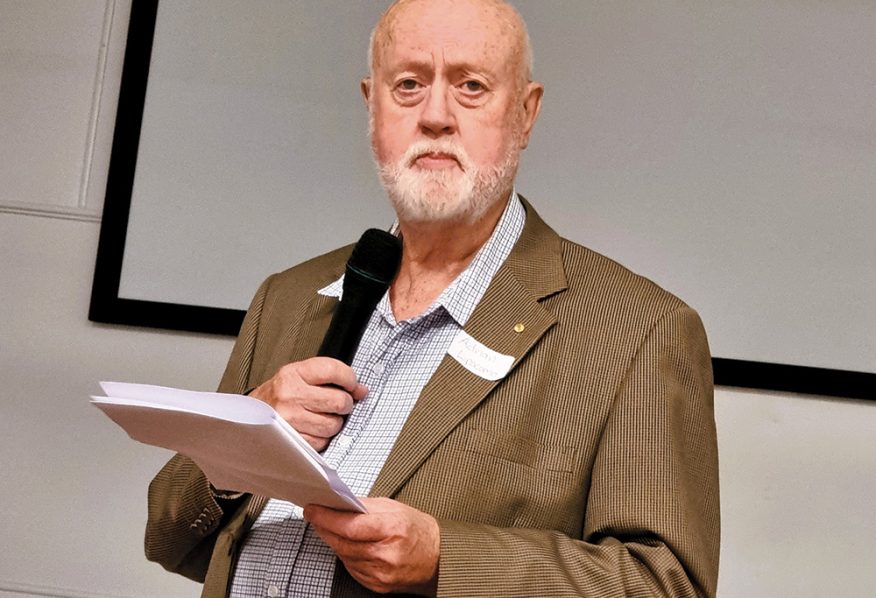
The region’s police Local Area Commander, Superintendent Joanne Schultz, was not able to attend due to flooding but retired local lawyer Adrian Lipscomb (OAM) was able to share his expertise as guest speaker.
Mr Lipscomb, who practiced mainly in criminal and civil litigation, discussed regional youth crime cases that he had been involved in and stressed the need for early intervention programs and empathy for the youth of today.
“I suggest that the lives of teenagers today are much more complex than they were when I was a teenager, and we should be somewhat sympathetic to that,” Mr Lipscomb said.
“We should all show empathy and compassion to the plight of young people today.”
He said the influence of mobile phone technology has stemmed the development of social and interpersonal skills.
“Social skills are needed to be empathetic. Empathy is a skill that needs to be cultivated by schools and parents with social and community activities such as volunteering programs.”
“In 2016, the High Court of Australia clarified the meaning of the doli incapax principle, which required that prosecutors prove that adolescent offenders understood the consequences of their actions.”
“Since then, conviction rates of children aged 10 to 13 have go down significantly.”
“A NSW Bureau of Crime Statistics research report found that putting younger children in prison does not address the cause of the crime. It only increases the risk of repeating it.”
“However, the NSW youth justice system is currently about 90 per cent full, indicating that the arrest rate is slowly increasing along with youth crime.”
Mr Lipscomb’s views on addressing youth crime are reflected in some of the 19 recommendations in an NSW parliamentary inquiry into regional youth crime interim report released last week.
The report comes after the inquiry received nearly 200 written submissions and four public hearings in regional towns including Kempsey.
It recommends more investment in regional youth hubs and improved access to drug and alcohol rehabilitation programs. Other early intervention recommendations included the NSW Department of Education collaborating with schools in disadvantaged regional and rural communities to identify and implement programs that holistically support the school community, including wellbeing hubs.
“Inquiry participants also emphasised that youth offending is a deeply complex social issue, and one that cannot be solved through increased policing alone,” the report states,
“Overwhelmingly, the evidence tells us that early intervention is the most effective way to prevent young people from engaging in criminal behaviour.”Economics is also a factor in the early intervention focus with the costs of detaining young now costing $2,700 a day or more than $1,000,000 per year.