
By Michael Burt
Will the Great Koala National Park be an economic boom or bust for the region? And will it save Koalas? Member for Oxley Michael Kemp says it will be far from great for north coast communities while key architect of the park Ashely Love says it will produce enormous environmental and economic benefits. Have your say by sending a letter to the editor at editor@bellingenshirenews.com.au
Koala Park spells disaster for communities
By Michael Kemp, Member for Oxley
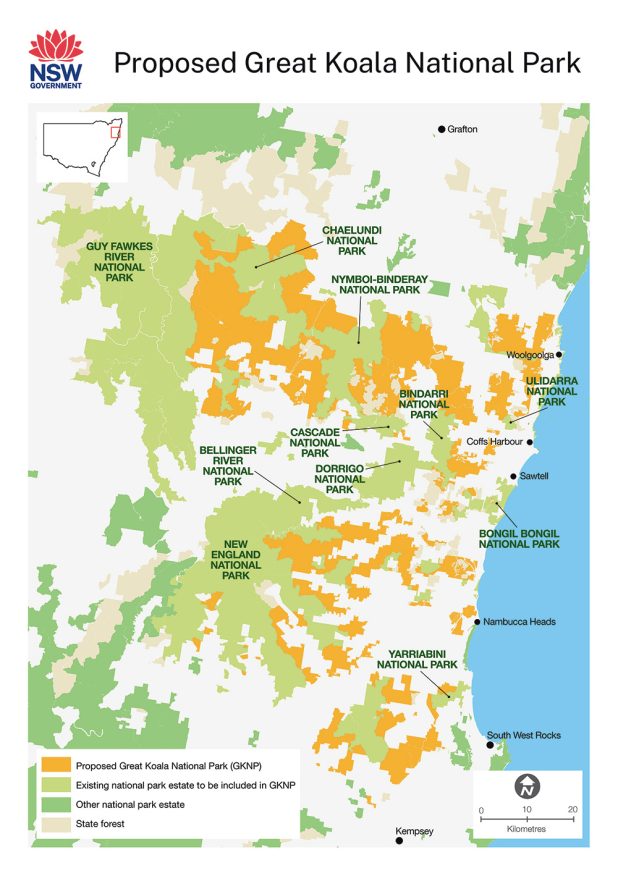
The announcement to lock up the full 176,000 hectares in the Great Koala National Park will have devastating consequences for our local communities.
In 2022–23, Australia imported $6.8B worth of timber, much of it sourced from countries where deforestation is rampant and environmental safeguards are non-existent. Every shipment that comes in is not just a job lost in regional NSW, but also money leaving the economy to subsidise practices we would never allow here.
With the NSW Government pressing ahead, those imports will only rise. That’s billions of dollars that should be staying in regional towns, supporting Australian workers, and backing industries that meet some of the strictest environmental conditions in the world.
Timber is not the enemy. It is the most sustainable building material we have. It grows back, sequesters carbon while growing, stores carbon in products, recycles naturally, and underpins renewable industries. Meanwhile, every phone, car, and high-rise tower relies on mining products which potentially have greater impacts than sustainable forestry ever could.
Dr Bradley Law, the lead scientist from the Department of Primary Industries, was gagged for years. His 7-year study across 224 sites with 25,000 hours of monitoring found that regulated timber harvesting in state forests had no effect on koala populations, nor did land tenure.
The real threats to koalas are wildfire, chlamydia, urban deforestation, cars, and dogs. Forestry doesn’t even make the top five. Yet the policy of locking up the GKNP is ignoring those threats.
Improving technology gives us better counts, with the CSIRO estimating 287,830 - 628,010 koalas in Australia and the NSW Governments high-tech drone survey, paid for by the public, backs it up with more than 12,000 koalas in the GKNP assessment area alone. Most in state forests, not national parks.
The financial imbalance is also stark. State forests currently operate with modest Community Service Obligations, $20M in total, or $8.50 per hectare. National parks, by contrast, carry obligations of $850M, or $121 per hectare. These figures come from a 2019 report, and no updated analysis has been provided. That’s a 14-fold cost difference per hectare, and taxpayers deserve transparency about whether these numbers have shifted.
If Victoria’s experience is any guide, the financial risks are enormous. When the Andrews Government shut down native forestry, it blew a $900M hole in the budget. Money spent paying out contracts, compensation, and transition packages. Where is the NSW Government going to find that kind of money?
If we’re serious about improving the environment, just look at the facts. NSW already has 7.6M hectares of national parks compared to just 2M hectares of state forest, 1.2M hectares of which are set aside for conservation. At a cost of $121 per hectare, have national parks really delivered the outcomes we were promised? And what
difference will locking up another 0.176M hectares for a name change actually make, for the environment, or for koalas? But it certainly will make a difference to the budget books for generations. Let’s manage our forestry for better environmental, recreational and financial outcomes.
A vital koala conservation park
By Ashley Love, Conservationist and Life member of the Bellingen Environment Centre (BEC)
Confirmation of the state Labor Government’s support for the community led Great Koala National Park (GKNP) proposal will lead to the creation of the third most important conservation reserve complex in NSW (behind only the Blue Mountains - Wollemi and Kosciuszko).
Continued from previous page
It will place the Environment Minister Penny Sharpe and the Minns Government alongside the former Wran and Carr
Governments as significant environmental reformers on the North Coast.
The conservation and expected ecotourism and economic gains from the Great Koala National Park will be enormous. Nevertheless, we must be prepared to continue to improve our management and recovery of koalas right across our local landscapes to ensure these gains are maximised and consolidated on the Mid North Coast.
The long-awaited GKNP announcement comes after 50 years of community-based campaigns to protect koala habitat in the Bellingen-Coffs Harbour region that will continue.
A major escalation of the ongoing campaigns were protests to stop logging in Pine Creek State Forest, where the conflict continued through most of the 1990’s.
That standoff morphed into a compromise – putting half of the state forest into Bongil Bongil National Park and continue logging of the remaining half and associated plantations.
Monitoring in Bongil Bongil National Park since has shown the koala population has stabilised but has not shown evidence of recovery towards earlier population levels. More habitat protection is clearly needed to encourage recovery.
Calls for increased protection for koala habitat increased dramatically during the first ten years of this century leading in 2010 to members of the BEC and other local conservation groups to pool resources and commission an assessment of koala populations on the Mid–North Coast between the Macleay and the Richmond Rivers.
The assessment identified 26 koala sub-populations in this area, 22 of which were assessed to be in various states of decline.
Whilst community members were reviewing the results of the assessment, the status of the koala was lifted from a common to a threatened species.
The community groups came forward with a proposal for a GKNP, including the protection of public lands in 14 of the 26 sub-populations and centred on the four assessed as having stable koala populations. The sub-populations in the park proposal were in the Guy-Fawkes to Coffs Harbour and the Bellingen –Nambucca- Macleay area and recognised as comprising amongst the best wild koala populations in the World.
Embedded in the community proposal was the concept of potential World Heritage listing for these koala populations which adjoined and, in some cases, overlapped with existing and tentatively listed rainforest World Heritage areas. That the koala, whose status was upgraded to endangered after the bushfires in 2019-20, meets the relevant World Heritage criteria for Threatened Species (Criteria X) to be: “of outstanding universal value for conservation or science”, is almost a certainty.
Before getting too excited there is a caution, and that is the nomination of the local koalas for World Heritage listing must clearly demonstrate the integrity of the conservation proposal to provide for recovery and management of the koala populations well into the future. Even with the proposed protection of native forests on native forests on public land there will still be many threats to the 14 local koala populations in the proposed Great Koala National Park.
In the Bellinger valley in particular the continued clear felling of plantations with known koalas is an issue for population integrity, which is added to by the fact that many of the original native forests on these areas were dominated by lowland rainforests, now an endangered ecological communities and prescribed for recovery actions.
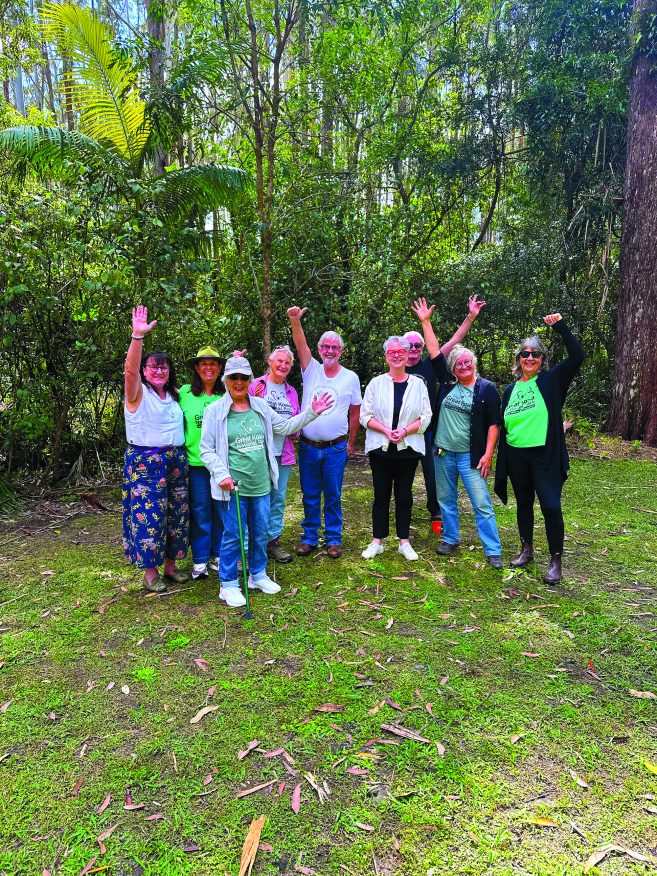
Members of the NSW National Parks Association of NSW celebrate the Great Koala National Park annoucement at Bongil Bongil National Park on Sunday.