

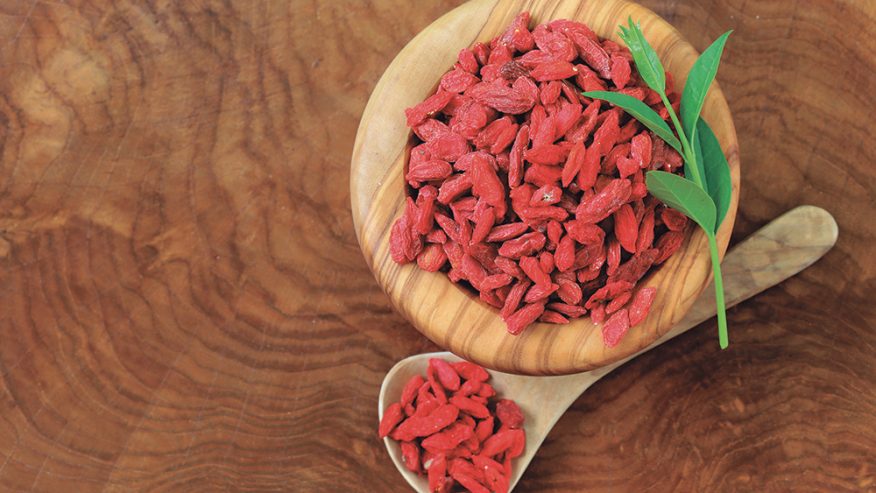
I love learning new things about the eyes and about health in general. Recently I learnt something new about eye health from a patient who’d come for an eye test. They told me that eating Goji berries is good for the eyes. Now, I know a little bit about the superpowers of the Goji berry from my days of endurance sport, but I did a little digging into their specific benefits for the eyes.
Macular degeneration (or more correctly, Age- Related Macular Degeneration) is an eye disease that you may have heard of. It’s the leading cause of blindness in Australia, and it damages a small but very important area at the back of the eye where our sharp, central vision comes from. This area is called the macula. It turns out that the wonderful little Goji berry contains a pigment with a funny name- Zeaxanthin. In fact, no other known dietary source beats Goji berries in terms of its Zeaxanthin content (1) This Zeaxanthin pigment, along with another pigment called Lutein, helps to protect the macula. A small study in 2021 found that regularly eating small handfuls of Goji berries (28mg of Goji berries, 5 times a week in this study) may help prevent or delay the development of Macular Degeneration. (2)
I’ve been singing the Goji Berry’s praises, but it’s not the only weapon against Macular Degeneration. According to the Macular Disease Foundation of Australia, other food-based nutrients that can help to protect the macula include Lutein, omega 3 fatty acids, Zinc, Selenium and Vitamins C and E. We can find Zeaxanthin and Lutein in dark green leafy vegetables (such as spinach and kale) as well as colourful veggies like yellow/orange capsicum, corn, carrots and peas and also eggs. Omega 3 fatty acids are found in fatty fish (such as salmon, tuna, mackerel, anchovies, trout, herring, sardines). We should be aiming to eat fatty fish 2-3 times a week. The good news is that, even though most of us prefer our fish fresh, even the frozen and tinned options will work for your dose of omega 3. If you’re not a fan of that much fish, I’m a big believer in omega 3 supplements to help preserve the macular health and as a bonus, it can even help dry eye syndrome!
Other things we can do to help our macular health are: don’t smoke! (this is the biggest modifiable risk factor for Macular Degeneration!), exercise regularly (a 30-minute stroll in the beautiful Bellingen shire will do wonders for the eyes in more ways than one), and protect your eyes from the sun by wearing sunglasses and a hat.
Regular eye tests are important in picking up on changes to the ocular health and discussing the best ways to look after YOUR eyes. Each person may have different risk factors when it comes to certain eye diseases and here at Panoptic Vision, we make sure to look at each individual’s unique vision and health situation and offer tailor-made advice. Please always remember that if you have any health conditions or take any medication, you should first discuss with your doctor or pharmacist before taking any new vitamins/ supplements or making any lifestyle changes as even natural supplements such as omega 3 can influence certain medications.
Book your eye test here – https://www.myhealth1st.com.au/appointmentWidget/makatea?practice_id=9310
1. Widomska J, SanGiovanni JP, Subczynski WK. Why is Zeaxanthin the Most Concentrated Xanthophyll in the Central Fovea?. Nutrients. 2020;12(5):1333. Published 2020 May 7. doi:10.3390/nu12051333
2. Li X, Holt RR, Keen CL, Morse LS, Yiu G, Hackman RM. Goji Berry Intake Increases Macular Pigment Optical Density in Healthy Adults: A Randomized Pilot Trial. Nutrients. 2021;13(12):4409. Published 2021 Dec 9. doi:10.3390/nu13124409