

When Bellingen Shire News last spoke with local educator and charity founder Deborah Neale in April, Emergency Pedagogy Without Borders Australia was a young organisation responding to the growing need for trauma-informed support after crisis.
Since then, the charity’s important work has taken another significant step.
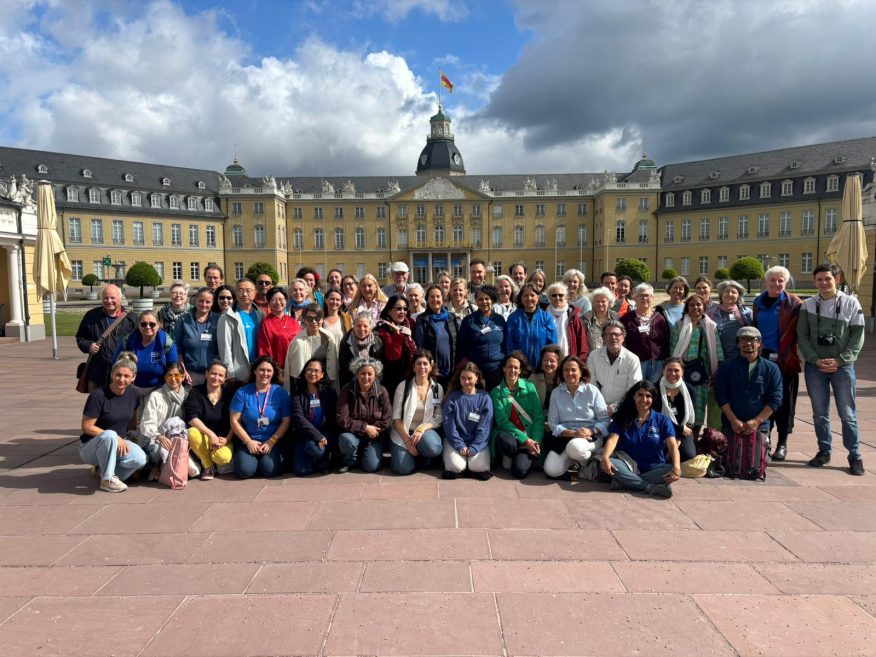
Deborah recently travelled to Karlsruhe, Germany, where she represented Australia at the 20th Anniversary of Emergency Pedagogy Without Borders at the inspiring Parzival Zentrum school. The conference brought together 160 participants from 30 countries to mark two decades of emergency pedagogy work supporting children and communities affected by war, violence, natural disaster and traumatic events.
Deborah, who lives in Bellingen and is the founder and Managing Director of Emergency Pedagogy Without Borders Australia, attended the conference with emergency pedagogue Mathis Engel. She was one of only four country representatives invited to present to the international gathering.
Her presentation shared the development of Emergency Pedagogy Without Borders Australia, including its response following the Bondi attack on 14 December 2025.
“It was a great honour to represent Australia and to share how this work is developing here,” Deborah said.
The strength of the Australian organisation has also led to Deborah being invited to support countries in Africa and the Asia-Pacific region as they develop their own Emergency Pedagogy Without Borders organisations.
Deborah was truly inspired by spending a week observing the trauma-informed education approach at Parzival Zentrum.
“Parzival Zentrum is not a school in the way we usually understand schools in Australia,” Deborah said.
“It is a whole community built around the dignity of the child. The classrooms, relationships, therapies, animals, farm, kitchen, youth housing and vocational pathways all work together to create safety, rhythm, purpose and belonging.”
“It’s a trauma-informed approach that does not simply manage children through individual behaviour plans, learning adjustments or crisis responses, but creates a whole-school culture where healing, learning and belonging can occur.”
Deborah said the learning from Germany has direct relevance for Bellingen, the Mid North Coast and regional schools, where many children, families and teachers are carrying the impact of disaster, housing stress, grief, family pressure and social disconnection.
During her visit, Deborah spent time in the Class 8 trauma stream and visited Birkenhof, Parzival’s youth housing project for young people aged 13 to 18. She met children affected by war, displacement, violence, family breakdown and repeated school exclusion.
Among them was 14-year-old Olexis, a refugee from Ukraine who now lives in Birkenhof and attends Parzival. He is supported by Sergiy, a 35-year-old father who fled Ukraine with his six-year-old son. Sergiy now works as a learning support at Parzival, helping Olexis navigate a new country, language, school life and separation from family.
“What struck me was that these children were not treated as problems to be managed,” Deborah said.
“They were met as human beings asking something of the adults around them. The question was not simply, ‘How do we stop this behaviour?’ The deeper question was, ‘What is this child asking of us, and what do we need to create so they can feel safe enough to grow?’”
Again and again at Parzival Zentrum, Deborah said she saw the same living question being asked:
“What is this child, young person or adult asking of us?”
And then:
“What do we need to create so this person can feel safe, belong, grow and bring something of themselves into the world?”
For Deborah, this is the question Australian schools are increasingly being called to face.
“If we want children to learn, we must first ask whether they feel safe enough to learn,” she said.
“That is the conversation I believe many Australian schools are ready to have.”
More information is available at emergencypedagogy.org.au.