
By Michael Burt
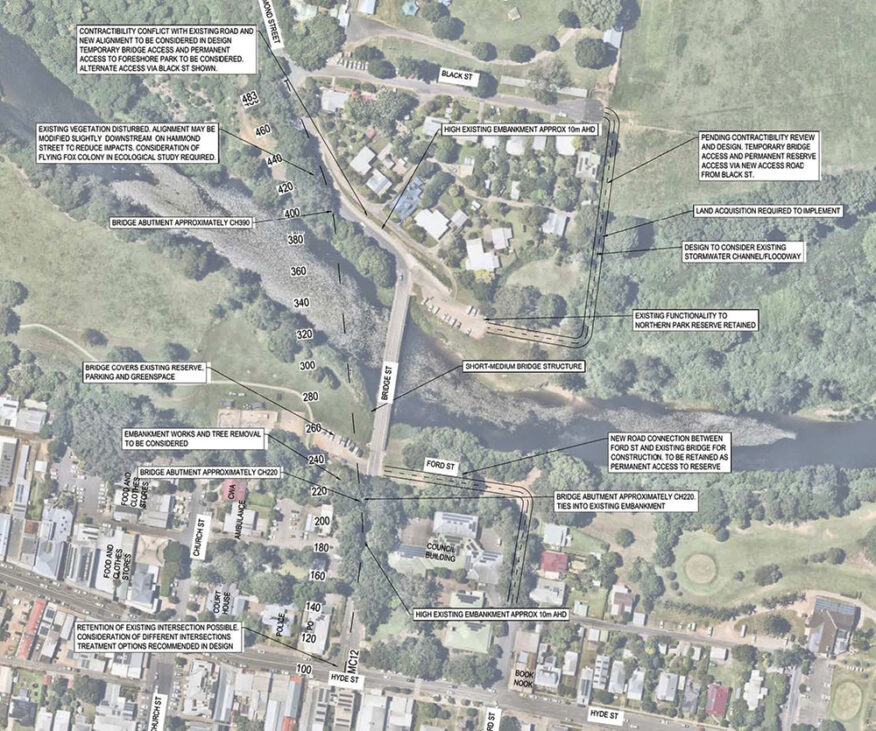
The proposed new Lavenders Bridge will be more than double its current height and moved around 25 metres upstream under the Bellingen Shire Council’s preferred option.
That option includes raising the road level raised from approximately 4.7 metres to 10 metres above sea level and allowing the existing bridge to remain operational for the majority of any future construction period.
The height of the proposed bridge was determined through flood modelling, engineering assessments, future funding requirements and practical considerations.
The current $365,000 investigation and design project is completely funded through the NSW Flood Recovery and Resilience Grant Program, with no Council co-contribution. Completing the design for the structure puts Council in a stronger position to seek State or Federal funding when replacement becomes necessary.
Council’s adoption of Option Two establishes the preferred alignment for further investigation and design. It does not commit Council to construction of the replacement bridge.
Community feedback on the future of Lavenders Bridge was presented to Bellingen Shire Councillors following the recent public exhibition of the Lavenders Bridge Options Assessment Report.
The outcomes of the consultation were initially presented at the September Councillor Information and Briefing Committee meeting, providing Councillors with an overview of community feedback and the technical considerations informing the preferred option.
The matter was subsequently considered at the October Ordinary Meeting, where Council adopted Option Two as the preferred alignment for the future replacement of Lavenders Bridge.
Council received 47 submissions from the public exhibition, with feedback centred around four key themes: the need and justification for replacement; cost and competing priorities; transport and access; and the character, riverfront and community amenity of the area.
Council said it acknowledges the strong connection the community has to Lavenders Bridge and the surrounding riverfront and understands that the preferred option presented may not reflect the preference of all respondents.
“The purpose of the investigation has been to identify the most feasible long-term option, balancing community considerations with engineering requirements, flood resilience, accessibility, construction impacts, whole-of-life costs and future funding requirements,” a spokeperson said.
“As a small regional Council, projects of this scale are generally beyond Council’s capacity to fund from its own revenue. Council is therefore reliant upon external funding from State and Federal Government Grant programs to provide funding for any eventual replacement.
Future funding applications are expected to place significant emphasis on improved flood resilience, reduced long-term maintenance requirements, increased asset life and improved access and safety.”
This increased height will make the bridge more resilient to flooding, with the design intended to withstand flood levels associated with a one-in-20-year event. The upgrade is expected to significantly reduce flood-related road closures, improve reliability for local residents and road users, and reduce ongoing maintenance costs.
“Ultimately, the new bridge will provide a safer, more reliable connection for the community, particularly during periods of heavy rainfall and flooding.”
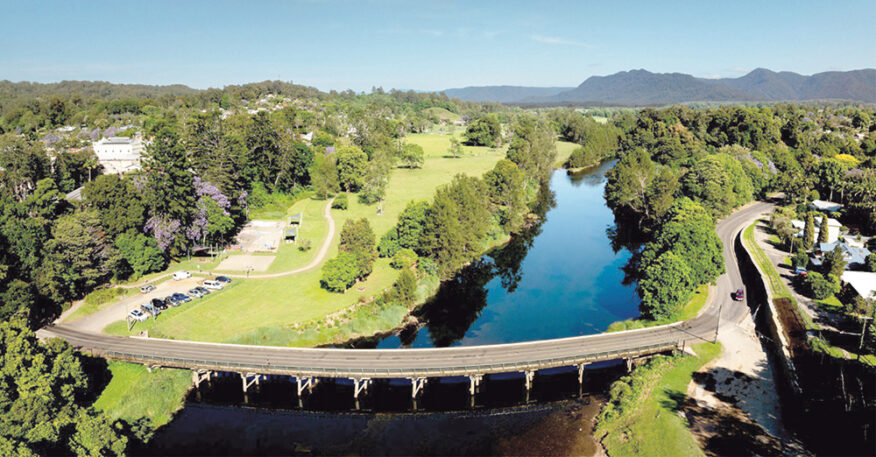
While the existing bridge has a concrete deck, its primary supporting structure is timber. Council would expect a timber bridge to have a lifespan of roughly 60 years. Constructed in 1993, the bridge is at approximately half its useful life, with replacement expected in the next 20-30 years.
“Given the importance of the connection and the scale and complexity of replacing a major bridge, Council considers it important to undertake planning and design work well in advance of when replacement is ultimately required. Importantly, there is currently no funding to construct a new bridge and no fixed replacement date.”
Further work would be required before any future construction, including relevant approvals and more detailed consideration of elements such as landscaping, architectural treatment and how the bridge integrates with the surrounding riverfront.